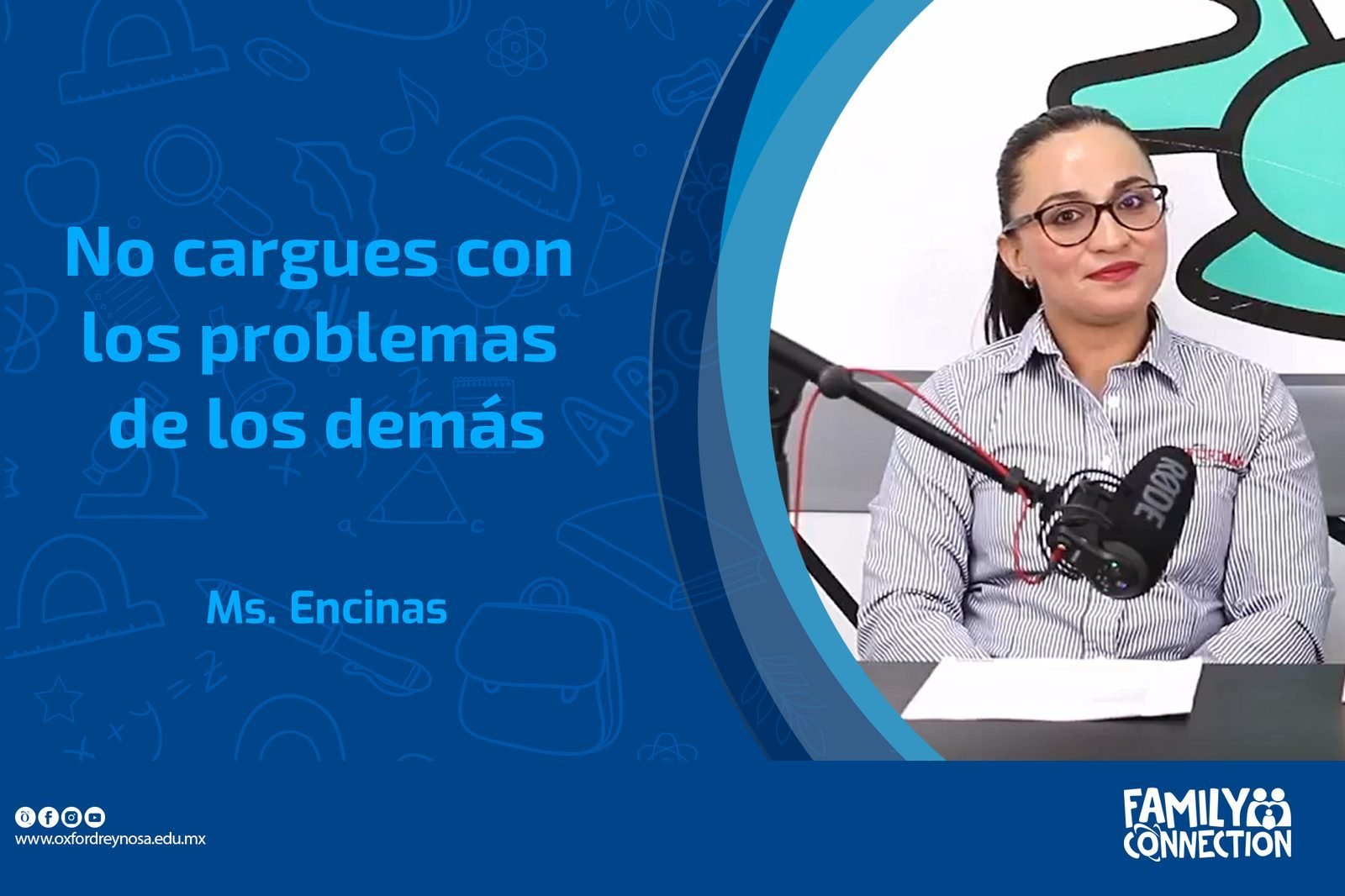
In our most recent Family Connection session we took up the theme “Don’t carry other people’s problems”. The talk was led by Ms. Cervantes, psychologist at Las Fuentes Campus, and included Ms. Encinas, Kindergarten coordinator at Vista Hermosa Campus, who brings 17 years of experience in education.
The session was inspired by the book of the same name by Gary B. Lundberg and Joy S. Lundberg. A reading club organised by Ms. Encinas and Ms. Arellano is currently running at Vista Hermosa Campus — a space in which parents reflect on the importance of letting go of what is not ours to carry, and of recognising that it is not always our responsibility to solve other people’s problems.
Our colleagues told us that the main theme on this occasion is that, as parents and staff, we often look to give our children or students immediate solutions without allowing them to make mistakes or to try doing things their own way. Far from benefiting them, this can do them harm and, in the long term, create dependence, as well as limiting the development of the reasoning, decision-making and responsibility skills they should be acquiring according to their age.
Some important points for not carrying other people’s problems, and for allowing children to learn to express themselves and to find solutions, are:
Validate emotions. Listen attentively, setting aside the phone and other distractions in order to understand what your child or student is trying to communicate.
Guide and accompany. It is fine to offer advice or an opinion while they search for answers and solutions, but do not solve things for them.
Encourage independence. Assigning small, age-appropriate tasks at home matters, so that they acquire a sense of responsibility.
Set respectful limits. Understand that positive parenting does not mean allowing everything a child wants simply because they want it or demand it.
Apply positive discipline. Encourage your children or students to find their own solutions, and in doing so foster their creativity and analytical thinking.
It was also highlighted that many young people and adults make the wrong decisions because they feel unseen or unheard within their social, family or educational circle. Most of them cannot even answer questions such as: What happened? Why did it happen? Where did you go wrong? This happens because, in childhood, they did not take on responsibilities and it was their parents or teachers who resolved things for them, preventing them from learning to take responsibility for their own actions.
At times parents believe they always hold the truth and the right solution, leaving no room for the child’s opinion. This limits their creativity, empathy and capacity to reason, and reinforces a dependence on others to solve problems.
At our school this approach aligns with our mission, which is to guide by providing tools and accompaniment, recognising how important it is that students grow, develop and learn from their own experiences.
Finally, we would like to share a line worth reflecting on:
Help your fellow man to lift his burden, but do not consider yourself obliged to carry it for him.
Pythagoras
En nuestra más reciente sesión de Family Connection, abordamos el tema “No cargues con los problemas de los demás”. La charla fue dirigida por Ms. Cervantes, psicóloga del Campus Las Fuentes, y contó con la participación de Ms. Encinas, coordinadora de Kínder en Campus Vista Hermosa, quien cuenta con 17 años de experiencia en la educación.
Esta sesión estuvo inspirada en el libro de Gary B. Lundberg y Joy S. Lundberg, el cual lleva el mismo nombre de esta sesión. En Campus Vista Hermosa se está llevando a cabo un club de lectura organizado por Ms. Encinas y Ms. Arellano, es un espacio en el que padres de familia reflexionan sobre la importancia de soltar lo que no nos corresponde y de reconocer que no siempre es nuestra responsabilidad resolver los problemas de los demás.
Nuestras colaboradoras nos contaron que el tema principal en esta ocasión es que, como padres y colaboradores, muchas veces buscamos dar soluciones inmediatas a nuestros hijos o alumnos, sin permitirles equivocarse o que ellos mismos intenten hacer las cosas a su manera. Esto, lejos de beneficiarlos, puede perjudicarlos y, a largo plazo, generar dependencia, además de limitar el desarrollo de habilidades de razonamiento, toma de decisiones y responsabilidad, que deben adquirir de acuerdo con su edad.
Algunos puntos importantes para no cargar con los problemas de los demás y permitir que los niños aprendan a expresarse y a resolver son:
• Validar las emociones. Escuchar con atención, dejar a un lado el celular y las distracciones para entender lo que el hijo o alumno intenta comunicar.
• Guiar y acompañar. Es válido dar un consejo u opinión en la búsqueda de respuestas y soluciones, pero no resolver por ellos.
• Fomentar la independencia. Asignar pequeñas tareas en casa, de acuerdo a la edad, es importante para que adquieran el sentido de la responsabilidad.
• Establecer límites respetuosos. Comprender que la crianza positiva no significa permitir todo lo que el niño quiere solo por gusto o exigencia.
• Aplicar la disciplina positiva. Motivar a que los hijos o alumnos encuentren sus propias soluciones, fomentando así su creatividad y pensamiento analítico.
Se destacó también que muchos jóvenes y adultos toman decisiones equivocadas porque sienten que no son vistos o escuchados dentro de su círculo social, familiar o educativo. Incluso, la mayoría no sabe responder a preguntas como: ¿Qué pasó? ¿Por qué pasó? ¿En qué te equivocaste?. Esto ocurre porque, en su infancia, no asumieron responsabilidades y, en su lugar, fueron sus padres o maestros quienes resolvieron por ellos, impidiendo que aprendieran a hacerse responsables de sus propias acciones.
En ocasiones, los padres creen tener siempre la verdad y la solución adecuada, sin dar espacio a la opinión de los niños. Esto limita su creatividad, empatía y capacidad de razonamiento, y refuerza la dependencia de terceros para solucionar problemas.
En nuestro colegio, este enfoque se alinea con nuestra misión, que es guiar proporcionando herramientas y acompañamiento, reconociendo la importancia de que los alumnos crezcan, se desarrollen y aprendan de sus propias experiencias.
Finalmente, queremos compartir una frase para la reflexión:
“Ayuda a tus semejantes a levantar su carga, pero no te consideres obligado a llevársela”. – Pitágoras.
We’re delighted you’re interested in giving your child a global education. Make it happen! Share your details and a member of our team will get in touch shortly.